
How to Choose Your Vacuum Level
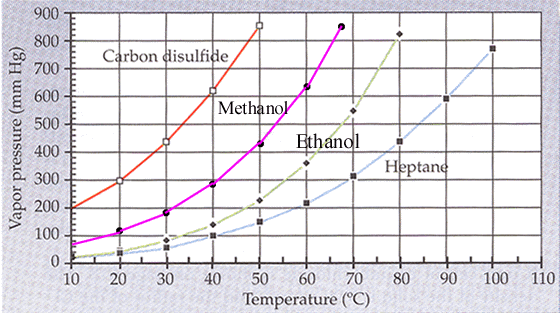
One of the challenges with wiped film distillation is correctly choosing the vacuum level for a distillation. This is a critical point, because choosing the wrong vacuum level can result in damage to vacuum pumps from solvent bypassing the condensers and cold traps.
If the composition of your feed material is known, this becomes fairly straightforward. If it is not known, it is still not too difficult, but this post will deal with what to do when you know the components of your mixture.
Let's say you have between 1-5% of a solvent and you are running a lab scale still with distillate receiving flasks that will be under vacuum. Since the solvent is known, you simply need to obtain a vapor pressure curve for the pure solvent and use that to choose an appropriate vacuum level.
The picture attached shows the boiling temperatures of four materials at different pressures. Most of the time, the best practice is to choose a pressure where your solvent boils at 20°C or higher.
The reason for this is your condenser can easily condense the solvent vapors without having to be too cold. For instance, if you are running a 15°C condenser and your solvent is Methanol, any pressure below about 75 mmHg would result in the methanol bypassing the condenser and proceeding to your cold trap. But if a pressure of 110 mmHg is applied, the 15°C condenser will work well.
The other reason for choosing pressures where the solvent boils at 20°C or above is because the pure solvent will collect in your distillate flask. Let's say you are removing methanol, and you chill your condenser to -20°C. Then you apply a vacuum of 60 mmHg and collect your methanol on that condenser. The distillate will run to your receiving flask and collect there. But that flask is at room temperature and the methanol in the flask boils at 10°C at 60 mmHg. Because of this, the contents of the flask will be consistently simmering, which is not an ideal way to fully remove methanol from your feed material.
It is best to choose conditions where the distillate is not boiling and then use heat as needed to fully remove the solvent from the feed material.
Therefore, for the four materials pictured here, the ideal pressures are as follows:
Carbon disulfide - run at 300 mmHg or above.
Methanol - run at 110 mmHg or above
Ethanol - run at 44 mmHg or above
Heptane - run at 40 mmHg or above
I hope this is a useful discussion.